
Coilover Setup for Track Days
Coilovers are easy to buy and surprisingly easy to make worse than stock. The adjustment range is the point, but it is also the problem. Ride height, rake, preload, damping, alignment, and tyre choice all interact.
For a GT86-style car, the goal is not to make it sit low in photos. The goal is a car that turns in cleanly, communicates what the rear axle is doing, and stays usable enough to drive to and from the track.
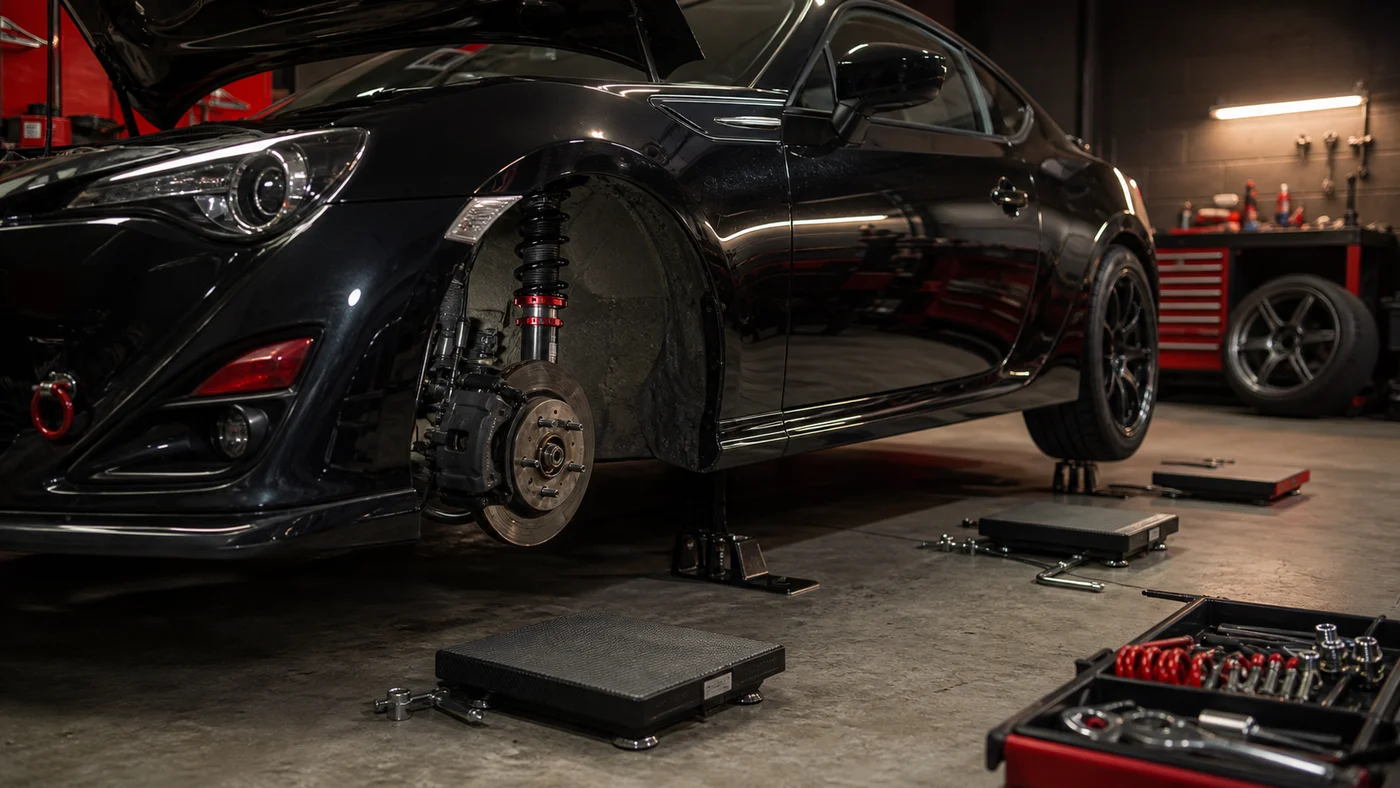
Start with a baseline
Before changing anything, I like writing down the boring numbers:
- current ride height at all four corners
- tyre pressures cold and hot
- alignment values
- damper settings
- fuel level
- driver weight assumption
Without that baseline, every change becomes a feeling. Feelings matter, but they need something to compare against.
Ride height is not just stance
Lower is not automatically better. Lowering changes suspension geometry, bump travel, and how much margin the car has over kerbs and rough roads.
On this kind of chassis I would rather keep a sensible amount of travel and make the car predictable. A car that looks aggressive but spends half the lap crashing into the bump stops is not faster. It is just busier.
The first target is a modest drop, then a check for clearance at full lock, compression, and real-world driveway angles. If it cannot survive normal use, the setup is not finished.
Corner balance
Corner balancing is where the setup starts feeling serious. The point is not making all four corner weights equal. That is usually impossible and not the target. The useful number is cross weight, measured with the driver weight represented in the car.
Small spring perch changes can move weight diagonally through the car. That is why randomly adjusting one corner to fix visual ride height can create handling weirdness somewhere else.
The process is slow: set tyre pressures, settle the suspension, measure, adjust, roll the car, settle again, measure again. It is not glamorous, but it is the difference between a setup and a guess.
Alignment after height
Ride height changes alignment, so alignment comes after the mechanical height work. For a track-biased GT86, front camber is usually more important than people expect. The front tyres need help if the car is going to survive repeated hard cornering without destroying the outer shoulders.
Toe is the setting I treat with the most caution. A little can change the personality of the car. Too much can make it nervous, slow, or both.
Damping
The damper knobs are not magic. If the spring rate, height, and alignment are wrong, clicking the dampers around will not fix the car.
I prefer starting in the middle of the adjustment range, then changing one axle at a time. The car should tell you whether the change helped. If two clicks feel better but four clicks feel worse, that is useful information. If every change feels random, something else in the setup is probably masking the result.
The road-car compromise
This is still a car that needs to work outside a circuit. That means no setup decision is free. More camber helps the tyre on track but can be annoying on the road. More stiffness can sharpen response but make the car skip over bad surfaces.
The best setup is the one matched to the actual use case. For me, that means quick enough to enjoy on track, clear enough in feedback to learn from, and civilised enough that I still want to drive it home.